
Private RAG on Local Models: Qwen3 vs Gemma 4 in 2026
In short
You can ship a production-grade private RAG system on a single $2,500 workstation in June 2026, and only two open-weight model families are worth your evaluation time: Alibaba's Qwen3.6 and Google's Gemma 4. I ran an identical 50-question eval over a client corpus on one RTX 4090: Gemma 4 26B MoE scored 42/50 on English questions at roughly twice the generation speed, while Qwen3.6 27B scored 41/50 in English and pulled clearly ahead once the documents went multilingual. Both fit in 24 GB of VRAM at Q4 quantization.
On this page
- Why are clients suddenly demanding no-cloud RAG?
- What does the local model landscape look like in June 2026?
- Build the reference single-machine private RAG stack
- Qwen3.6 27B or Gemma 4 26B MoE: which is better for RAG?
- Is local RAG actually cheaper than a cloud API?
- When does cloud still win?
- Key takeaways
Why are clients suddenly demanding no-cloud RAG?
Because their contracts now say so. Three of my last five RAG inquiries included a clause forbidding any third-party API from touching the documents: a law firm bound by privilege, a clinic handling patient records, and a German manufacturer with a GDPR data-residency requirement. The quality gap that used to justify pushing back on those clauses has closed.
Private RAG is a retrieval-augmented generation system where the documents, embeddings, vector database, and language model all run on hardware you control, so no token ever crosses the network boundary.
Through 2024 and most of 2025 I talked clients out of this setup. Local models retrieved fine, but their synthesis was noticeably worse than a mid-tier cloud model, and I did not want my name on a system that answered legal questions badly. That objection died this year. With the early 2026 open-weight releases, the deciding factors are compliance and cost, not capability.
The commercial reality is blunt: if a legal or healthcare client cannot sign off on data leaving the building, a cloud RAG proposal is dead on arrival no matter how good the demo looks. A private build is the difference between winning and losing those contracts. I price these at the top of my usual $4k to $12k RAG MVP range, with hardware billed at cost.
What does the local model landscape look like in June 2026?
Two families matter, and both moved this spring. Gemma 4 released on March 31, 2026 under Apache 2.0 in four sizes, and the unified multimodal, encoder-free Gemma 4 12B followed on June 3, 2026, one week before I published this. Alibaba shipped Qwen3.5 in February 2026 and the open-weight Qwen3.6 after it.
The Gemma 4 lineup, as of June 2026: E2B for phones, E4B for edge devices, a 26B mixture-of-experts for consumer GPUs, and a 31B dense model for workstations, all with 256K context and 140+ language coverage. The 31B scores 85.2% on MMLU Pro, and the 26B MoE activates only 3.8B parameters per token, which is why it runs interactive RAG on one consumer GPU. The E2B tier continues the on-device trend I tested when I ran Apple's Foundation Models inside a React Native app ↗; the same logic now applies to desktops.
Qwen3.6 ships as a 27B dense model and a 35B MoE, both Apache 2.0, both 256K context, with multimodal input and a hybrid-thinking mode you can toggle per request. The consensus among practitioners, which matches my own testing, is that Qwen3.6 27B at Q4 in roughly 24 GB of VRAM is the best overall model you can run on consumer hardware as of June 2026.
Build the reference single-machine private RAG stack
My reference build is one machine: an RTX 4090 or 5090, or a Mac with 64 GB of unified memory, running Ollama for model serving, nomic-embed-text for embeddings, Postgres with pgvector for storage, and a Node/TypeScript pipeline on top. Total hardware cost lands near $2,500 if you buy new, less if you find a used 4090.
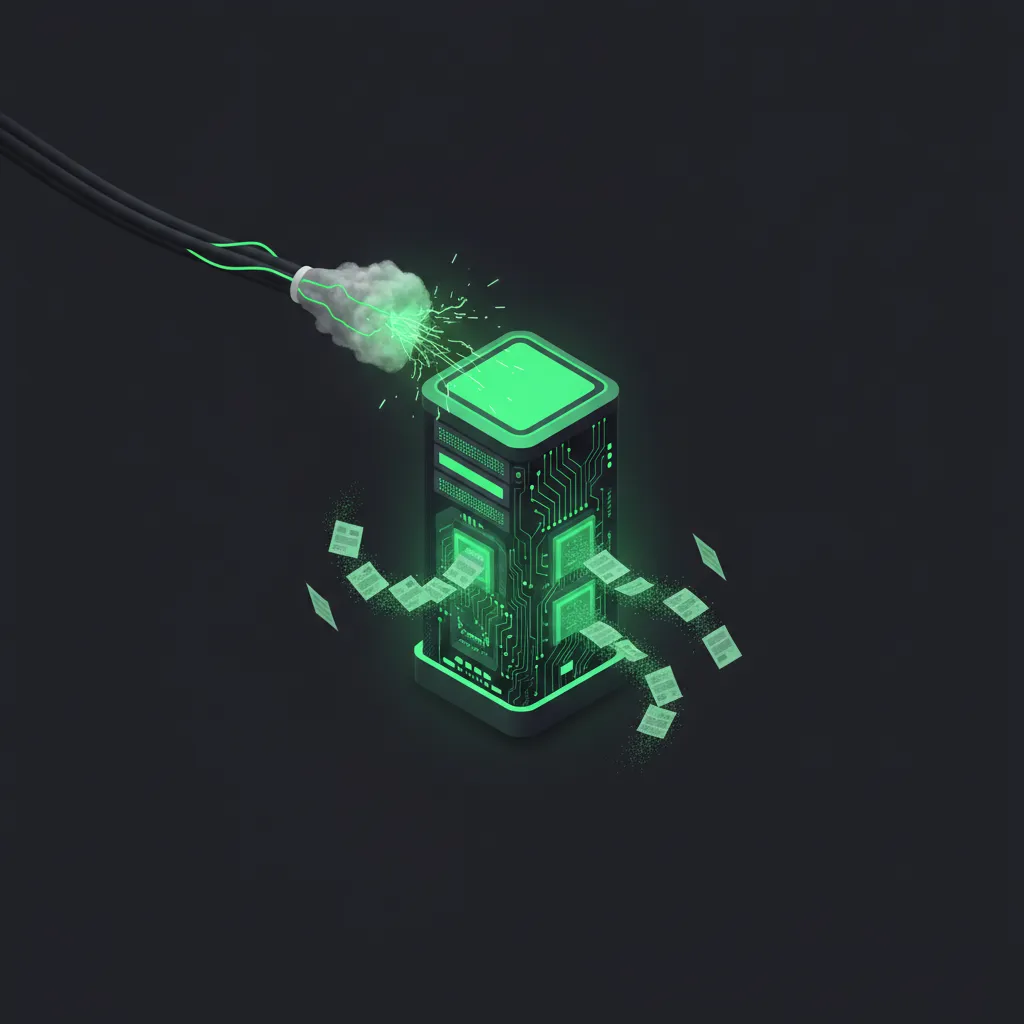
This is the same stack I deploy in my RAG development engagements ↗, and nothing in it phones home. Qdrant is a fine swap for pgvector if you want a dedicated vector store, but for corpora under a few million chunks I have never needed it.
Here is the build, start to finish:
- Install Ollama and pull both candidate models so you can eval them against each other before committing.
- Pull the embedding model: nomic-embed-text runs alongside the LLM in spare VRAM.
- Stand up Postgres 17 with pgvector in Docker, one table for chunks, one HNSW index.
- Write the ingestion pipeline in TypeScript: parse, chunk at 600 to 800 tokens with 15% overlap, embed through Ollama's REST API, upsert.
- Build the query endpoint: embed the question, fetch the top 12 chunks, rerank down to 5 with a small local cross-encoder, prompt the model.
- Add a faithfulness guard: instruct the model to answer only from the provided context and to say so when the context does not contain the answer.
- Run a real eval before go-live: 50 actual user questions graded by hand beats any leaderboard.
ollama pull gemma4:26b        # MoE, ~16 GB at Q4_K_M
ollama pull qwen3.6:27b       # dense, ~17 GB at Q4_K_M
ollama pull nomic-embed-text  # embeddings, fits in leftover VRAM
VRAM for the weights per quantization, before KV cache (budget 2 to 4 GB more at 16K context):
| Model | Q8_0 | Q5_K_M | Q4_K_M | Fits 24 GB at Q4 with 16K context? |
|---|---|---|---|---|
| Qwen3.6 27B | ~29 GB | ~20 GB | ~17 GB | Yes |
| Gemma 4 26B MoE | ~28 GB | ~19 GB | ~16 GB | Yes |
| Gemma 4 31B | ~33 GB | ~23 GB | ~19 GB | Barely, short context only |
| Gemma 4 12B (multimodal) | ~13 GB | ~9 GB | ~7.5 GB | Yes, with headroom |
Qwen3.6 27B or Gemma 4 26B MoE: which is better for RAG?
For an English corpus, pick Gemma 4 26B MoE: it matched Qwen3.6 on accuracy in my eval while generating at roughly twice the speed. For multilingual or code-heavy corpora, pick Qwen3.6 27B. I reached this by running an identical 50-question eval over the same private corpus, same retrieved chunks, same prompt template.
| Spec | Qwen3.6 27B | Gemma 4 26B MoE | Gemma 4 31B |
|---|---|---|---|
| VRAM at Q4_K_M (weights) | ~17 GB | ~16 GB | ~19 GB |
| Active params per token | 27B (dense) | 3.8B | 31B (dense) |
| Context window | 256K | 256K | 256K |
| Languages | 119 | 140+ | 140+ |
| License | Apache 2.0 | Apache 2.0 | Apache 2.0 |
| tok/s on RTX 4090, Q4 | ~31 | ~64 | ~22 (tight fit) |
The corpus was 1,400 anonymized documents from a legal client (contracts, internal policies, regulatory PDFs, used with permission). The client's paralegal wrote 50 questions; I graded answers by hand for accuracy and for faithfulness, meaning the percentage of generated claims traceable to a retrieved chunk.
The English results: Gemma 4 26B MoE answered 42/50 correctly (84%) at 94% faithfulness, averaging 6.1 seconds per answer. Qwen3.6 27B answered 41/50 (82%) at 95% faithfulness, averaging 11.8 seconds. With hybrid-thinking enabled, Qwen climbed to 43/50 but average latency roughly tripled, which kills the interactive feel users expect. Then I ran 20 German and Urdu questions over a second corpus: Qwen3.6 scored 17/20, Gemma 4 26B MoE scored 13/20. Gemma's 140+ language coverage is broad but shallower in my testing; Qwen's 119 languages run deeper in the ones my clients actually use.
On long context, both stayed coherent with 64K tokens of stuffed chunks, and Gemma started drifting past roughly 96K. The honest caveat is that prefilling 64K takes most of a minute on a 4090, so retrieve less and rerank harder instead of stuffing context.
For private RAG in 2026, Gemma 4 26B MoE is the English-corpus sweet spot on a single GPU; Qwen3.6 27B wins the moment your documents go multilingual or code-heavy.
My verdict matrix by corpus type:
| Corpus type | My pick |
|---|---|
| English legal or medical documents | Gemma 4 26B MoE |
| Multilingual (EU clients, 2+ languages) | Qwen3.6 27B |
| Code-heavy technical documentation | Qwen3.6 27B |
| Scanned PDFs and images in the corpus | Gemma 4 12B multimodal for extraction, 26B MoE for synthesis |
| 32 GB+ GPU available (RTX 5090) | Gemma 4 31B |
Is local RAG actually cheaper than a cloud API?
At sustained volume, yes. The $2,500 workstation amortizes to about $104 a month over 24 months, plus roughly $25 of electricity, and that flat cost covers unlimited queries. The comparable cloud deployments I run bill $150 to $450 a month in inference at 10k to 40k queries, so breakeven lands between month 6 and month 14.
Two honest qualifiers. First, my build fee is similar either way, and setup labor dominates the total project cost; I broke that math down in how much a RAG chatbot costs to build ↗. Second, the client trades elastic scale for a physical box someone has to keep alive: driver updates, disk space, a UPS. At low volume, say a few hundred queries a month, cloud stays cheaper indefinitely. Every private build I have sold was bought for the data guarantee; the cost savings were a bonus that showed up later.
When does cloud still win?
Cloud wins on three things: frontier-grade reasoning, managed rerankers, and elastic scale. If your users ask ambiguous multi-step questions, the strongest cloud models still out-reason anything that fits in 24 GB of VRAM, and no local stack matches a managed pipeline when traffic spikes tenfold overnight.
That reasoning gap matters more as retrieval gets agentic, with models planning their own multi-hop searches, a shift I covered in whether RAG is dead in 2026 ↗. The pattern I increasingly recommend is hybrid: local models touch the sensitive documents, a cloud model handles non-sensitive planning and routing. Deciding where that boundary sits is the first conversation in most of my AI solutions work ↗ this year.
Key takeaways
- Private RAG ships on one $2,500 machine in 2026: Ollama, nomic-embed-text, pgvector, and either Qwen3.6 27B or Gemma 4 26B MoE inside 24 GB of VRAM.
- Gemma 4 26B MoE matched Qwen3.6 27B on my 50-question English legal eval (42/50 vs 41/50) while generating about twice as fast, because only 3.8B parameters activate per token.
- Qwen3.6 27B won my multilingual eval 17/20 to 13/20 and is the stronger pick for code-heavy corpora.
- The hardware pays for itself in 6 to 14 months at sustained volume, but compliance, not cost, is why clients buy these builds.
- Keep retrieved context under 16K tokens and rerank aggressively; 64K prefill works on both models but takes most of a minute on a 4090.
FAQ
Can I run a production RAG system fully offline in 2026?
Yes. I have client systems in production with no outbound network access at all: Ollama serving Gemma 4 26B MoE or Qwen3.6 27B, nomic-embed-text for embeddings, and pgvector for storage. Answer quality is close enough to mid-tier cloud models that compliance, not capability, now decides the architecture.
What hardware do I need to run Qwen3 or Gemma 4 locally?
A 24 GB GPU such as an RTX 4090 runs either model at Q4 quantization with a 16K context, which is plenty for reranked retrieval. A Mac with 64 GB of unified memory also works, with slower generation. Gemma 4 31B wants 32 GB, so budget an RTX 5090 for it.
Is local RAG cheaper than using the OpenAI API?
At sustained volume, yes. My $2,500 workstation costs roughly $130 a month amortized, including power, regardless of query count, while comparable cloud inference bills me $150 to $450 a month. Breakeven arrives between 6 and 14 months. At low volume cloud stays cheaper, and compliance remains the stronger reason to go local.
Working on something like this?
I build web apps, AI features, and mobile products for clients. If this article matches a problem you have, tell me about it.
Start a conversationMalik Hamza Shabbir · Full-Stack & AI Engineer
I build full-stack and AI products solo: a reputation SaaS in production, RAG pipelines, and React Native apps. I write from what I ship, not from documentation summaries.
Run it on yours
Every number above came from code you can read.
The harness is open and the per-probe log ships with it. If you build one of these systems, or you are choosing between them with real money, the same method is available to you.
Send me an endpoint and I will write an adapter, run it on the same workload under the same rules, and publish the result. It goes in the table whether it wins or not.
Sponsored inclusion is disclosed in the article and the result publishes either way. Paying moves you up the queue, never up the table.
Related articles
What an AI Support Agent Actually Costs in 2026, and When Intercom Fin's $0.99 Is the Cheaper Choice
I priced a custom AI support agent on Claude Sonnet 5 against Intercom Fin's $0.99 per outcome at 1,000, 5,000 and 20,000 conversations a month, with every assumption shown and the costs most quotes leave out.
I Benchmarked 5 AI Agent Memory Systems. The Best Scored 57.6%.
Mem0, Zep, Letta, LangMem and GoodMem on the same 419-turn conversation, graded only on the text they retrieved. Vendors publish 80-93% on LoCoMo. The best here scored 57.6%. Open harness, every number reproducible.
RAG, Fine-Tune, or Just Prompt? A 2026 Decision Tree for Million-Token Context Windows
Cheaper long context in 2026 broke the old always-RAG advice. Here is the decision tree I use: when full-context prompting beats a pipeline, when RAG is mandatory, when fine-tuning earns its keep, plus the hybrid stack and a cost and latency comparison.